
Ditch Hotels: Furnished Rentals in San Antonio
Travel Housing, Furnished Rentals, San Antonio
Why Traveling Professionals Are Ditching Hotels for Furnished Monthly Rentals in San Antonio
If you live on the road for work, you already know this: extended hotel life looks glamorous on paper and feels exhausting in real life. There is a smarter way to do San Antonio assignments—and it starts with rethinking where you sleep, work, and recharge.
1. The Grind of Extended Hotel Living (You’re Not Imagining It)
A few nights in a hotel is fine. Thirty, sixty, or ninety nights? That’s a grind. The little inconveniences you shrug off on a weekend trip become real friction when you are on assignment in San Antonio for months at a time.
Inconsistent Wi‑Fi: You are trying to chart, submit reports, or jump on a Teams call—and the hotel Wi‑Fi decides today is not the day. Paid “premium” Wi‑Fi often just means paying more to buffer in HD.
No real kitchen: A mini‑fridge, a microwave, and a coffee maker are not a kitchen. You end up living on DoorDash, takeout, and lobby snacks, which hits both your wallet and your energy levels.
Laundry hassles: Lugging scrubs or work clothes to a shared laundry room—or paying hotel prices per item—gets old fast. You are either out of quarters or out of patience.
No real workspace: That tiny desk wedged between the bed and the AC unit is not a productive office. You are one swivel away from your pillow and the TV remote, which is not great for focus or boundaries.
Zero privacy or routine: Housekeeping knocking, thin walls, hallway noise, shared elevators, no place to truly decompress. You are always “on,” even when you are off shift.
For a weekend, you tolerate it. For a 13‑week travel nurse contract, a 90‑day consulting project, or a three‑month remote work trial in San Antonio, it slowly drains your energy, your budget, and your sanity. That is why so many professionals are shifting from hotels to furnished monthly rentals designed for real life, not just overnight stays.
2. What “Traveling Professional” Really Means in 2026
In 2026, “traveling professional” is no longer just the classic road‑warrior salesperson. It is a wide spectrum of people whose work and life depend on having the right temporary home base for 30+ days at a time—often in secondary markets like San Antonio that are booming with opportunity.
Healthcare travelers: Travel nurses, allied health professionals, and locum tenens providers rotating through Methodist, Baptist, University Health, and Brooke Army Medical Center. You need quick commutes, safe neighborhoods, and a place to reset between shifts.
Corporate consultants and project managers: Professionals embedded with teams at USAA, financial services firms, utilities, and large-scale infrastructure or manufacturing projects. You are juggling calls across time zones and client deliverables from one temporary HQ.
Remote workers and digital nomads: People doing geographic arbitrage—keeping a big‑city salary while enjoying San Antonio’s more affordable cost of living, culture, and space. You are here to work hard and actually enjoy your off hours, not camp out in a hotel corridor.
Executive relocators and trial movers: Leaders testing a new role or market, or families relocating to San Antonio who need a soft landing before committing to buying. You need something that feels like home while you make big decisions.
Government and defense contractors: Professionals tied to Joint Base San Antonio, cybersecurity hubs, or federal projects who need secure, consistent housing that respects early mornings, late nights, and confidentiality.
Across all of these roles, one thing is consistent: you are not on vacation. You are here to perform. That means your housing has to support your work, your health, and your routine—not fight against it.
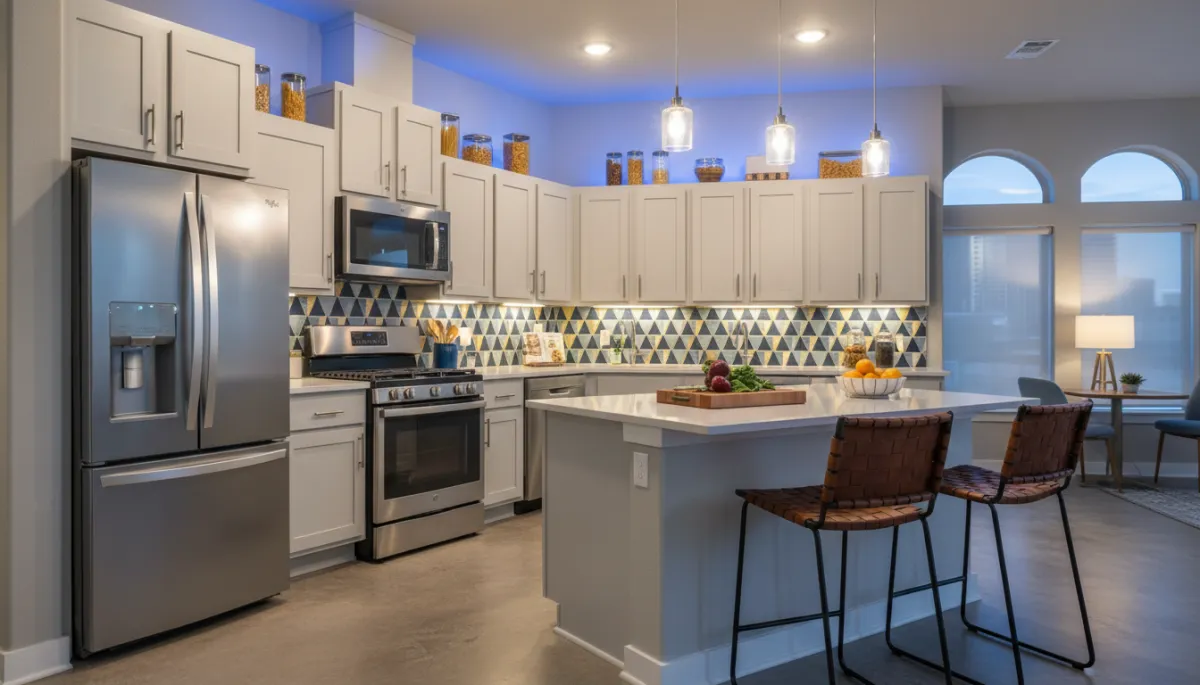
A real kitchen lets you swap late-night takeout for quick, healthy meals between shifts.
3. The Real Cost of Hotel Life at 30, 60, and 90 Days
Let’s talk numbers. In San Antonio, a “decent” extended‑stay hotel can easily run $130–$170 per night once you factor in taxes and fees. Split the difference at $150 per night:
30 days × $150 = $4,500
60 days = $9,000
90 days = $13,500
Now compare that to furnished monthly rentals in San Antonio. Recent 2026 data shows:
Furnished 1‑bedroom: typically $1,300–$1,450 per month.
Furnished 2‑bedroom: about $1,700–$1,950 per month—often shared by two travelers.
Even if you choose a higher‑end, all‑inclusive home in the $2,200–$2,600 range, you are still far below hotel pricing for a 30‑day stay—and you are getting a full home, not a single room. Some ultra‑flexible month‑to‑month homes in San Antonio do start around $3,200+, but again, that is often for an entire house, not a basic room with a bed and a TV.
📌 Key Takeaway: Over a 90‑day assignment, moving from a $150/night hotel to a well‑priced furnished rental can easily save $4,000–$7,000—before you even factor in food, laundry, or parking.
And that is just the financial side. The bigger gap is quality of life: being able to cook, spread out, do laundry on your schedule, and actually feel at home instead of living out of a suitcase on a luggage rack.

A real workspace changes how you show up for patients, clients, and your team.
4. What a Furnished Monthly Rental Actually Gives You
A good furnished monthly rental is not just “a place to crash.” It is a fully functional home set up for real life and real work. Here is what that looks like in practice when you choose the right provider in San Antonio:
Full kitchen: Full‑size fridge, oven, stove, microwave, dishes, cookware, and basic tools. You can meal prep, pack your own lunches, and eat something green once in a while. Your body and your budget will both notice the difference in week one.
Real workspace: A proper desk or table, a comfortable chair, decent lighting, and enough outlets. You can chart in peace after a night shift, run client calls, or handle admin without balancing your laptop on a bedspread.
In‑unit laundry: Washer and dryer in the unit, not down the hall. Wash scrubs, uniforms, or gym clothes on your schedule, not the hotel’s. No more feeding machines quarters at midnight or paying per‑item hotel rates.
Reliable, high‑speed Wi‑Fi: Not “shared with 200 other rooms” Wi‑Fi. You need stable internet for EMR systems, secure portals, video calls, and streaming something mindless when your brain is fried. Good rentals treat Wi‑Fi as essential infrastructure, not an add‑on.
Your own space: A living room that is not your bedroom, a real sofa, maybe a small patio or yard. You can host a coworker for dinner, FaceTime family without whispering, and actually feel like a person with a life—not a permanent hotel guest.
The bottom line: a furnished monthly rental gives you the infrastructure to live like a local while you work like a pro.

Smarter housing choices free up budget and mental bandwidth for what matters.
5. Why San Antonio Is a Magnet for Traveling Professionals
San Antonio is no longer just “the city with the River Walk.” It is a serious hub for healthcare, defense, tech, and corporate projects—and that means a steady stream of traveling professionals who need reliable, mid‑term housing.
Healthcare: Systems like Methodist, Baptist, University Health, and Brooke Army Medical Center drive constant demand for travel nurses, therapists, and allied health pros. Rotations and 13‑week contracts are the norm, not the exception.
Defense and government: Joint Base San Antonio, cybersecurity operations, and federal contractors bring in rotating teams with tight security requirements and non‑traditional schedules. They need housing that is stable, quiet, and commute‑efficient.
Corporate and tech: USAA and other financial services, insurance, and tech‑adjacent firms draw consultants, trainers, and project managers for multi‑month engagements. These teams need a place to plug in quickly and work from “home” between on‑site sessions.
Remote workers and relocators: Compared to Austin and other Texas metros, San Antonio still offers more value for your housing dollar. That makes it a prime base for remote workers who want culture, food, and space without coastal prices.
All of this adds up to a city where mid‑term stays—30, 60, 90 days or more—are normal. The old “just throw them in a hotel” model does not match how people actually work here anymore, which is exactly why providers focused on furnished monthly rentals have stepped in.
6. How to Find the Right Furnished Monthly Rental in San Antonio
Not every “furnished rental” is created equal. Some are basically student housing with a couch. Others are thoughtfully set up for professionals like you. Here is how to separate the two quickly.
What to Look For
Proximity to your assignment: Check drive times to your hospital, client site, base, or coworking space at your actual shift start and end times—especially if you are on nights or early mornings.
Clear, professional photos: Look for current, high‑quality photos that show the whole space: bedroom, living area, kitchen, bathroom, workspace, parking. Blurry or incomplete photos are a red flag for surprises on arrival.
Included utilities and Wi‑Fi: Confirm what is covered: electricity, water, trash, internet, streaming services. Ask for Wi‑Fi speeds in writing if you rely on video calls or VPNs.
Real furniture, not leftovers: You want a comfortable mattress, solid sofa, usable dining table, and enough storage. If it looks like a random mix of old pieces, expect that in real life too.
What to Ask Before You Book
“Is there in‑unit laundry? If not, where is the nearest laundromat and how safe is it late at night?”
“What is the parking situation? Assigned space, garage, street parking, or first‑come‑first‑served?”
“Are there quiet hours or noise issues I should know about?” (Especially important if you sleep during the day.)
“How do you handle maintenance requests? Who do I text or call, and what is the typical response time?”
What to Avoid
Vague listings with no mention of Wi‑Fi, utilities, or parking.
Hosts who cannot clearly explain their cleaning standards or maintenance process.
Spaces that look like party pads, not professional homes—if the listing screams “bachelor weekend,” it will not feel like a calm base for 12‑hour shifts.

When your housing feels like home, you recover faster between demanding workdays.
7. The Productivity Angle: Your Environment Is a Performance Tool
This is not just about comfort. Your housing is a performance tool. When you are on a high‑stakes contract—caring for patients, leading a project, supporting a base—your home environment directly affects how you show up on the job.
Sleep: A quiet, dark bedroom and a decent bed mean deeper sleep and better reaction time. Thin hotel walls and hallway noise do the opposite—especially if you are flipping between day and night shifts.
Focus: A defined workspace lets your brain switch into “work mode” and then out again. That separation is nearly impossible when your only options are the bed or a tiny desk three feet away from it.
Nutrition and movement: Having a kitchen and nearby parks or walking paths makes it easier to eat real food and move your body. That is not a wellness cliché; it is what keeps you from burning out in week four of a tough assignment.
💡 Pro Tip: When you evaluate housing, ask yourself: “Will this setup make it easier or harder for me to do my best work for 90 days straight?”
8. Why Legacy Crashpads Is the Smart Choice for San Antonio Assignments
Legacy Crashpads exists for one specific type of guest: traveling professionals on real assignments in San Antonio. Not tourists. Not party groups. People like you who need a stable, comfortable, and efficient base for 30+ days while you do important work.
Thoughtful locations: Properties are chosen with proximity to major hospitals, bases, and corporate hubs in mind—so your commute is predictable, not a daily surprise from a random listing.
Set up for work and rest: Every unit is furnished with real mattresses, functional workspaces, and living areas that feel like home, not like a leftover furniture warehouse.
Professional‑grade Wi‑Fi and utilities included: You are not guessing what your final bill will be or fighting with hotel‑style networks. Utilities and internet are part of the package, so you can just plug in and get to work.
In‑unit laundry and full kitchens as standard, not upgrades: Because doing laundry at midnight and living on takeout is not a long‑term strategy for anyone’s health or budget.
If you are a travel nurse heading into a 13‑week contract, a consultant leading a multi‑month project, a remote worker testing out San Antonio, or a government contractor rotating through Joint Base San Antonio, you do not have time to gamble your housing on a random listing.
A furnished monthly rental through Legacy Crashpads lets you land, unpack once, and get into a rhythm quickly. No hotel grind. No endless logistics. Just a stable, comfortable base that supports the reason you are here in the first place: to do your best work, and still have a life when your shift or workday ends.
If your next assignment is in San Antonio, you do not have to choose between overpriced hotels and sketchy short‑term listings. There is a middle path: professional, furnished monthly housing built for travelers like you. That is exactly what Legacy Crashpads delivers.
Disclaimer: Content published by Legacy Crash Pads is provided for general educational and informational purposes only and should not be considered legal, tax, insurance, real-estate, financial, or other professional advice. Information may change and may not apply to every individual, company, project, insurance claim, military assignment, or housing situation.
Property availability, pricing, amenities, locations, policies, minimum-stay requirements, and housing eligibility are subject to verification and may change without notice. Nothing published on this website constitutes an offer, promise, guarantee of housing, guarantee of results, or contractual commitment.
References to insurance companies, ALE providers, military installations, government agencies, employers, construction companies, staffing companies, or other third parties do not imply affiliation, sponsorship, endorsement, or approval unless expressly stated. Readers should independently verify all information and consult the appropriate qualified professional before making legal, insurance, housing, tax, financial, or business decisions.