
San Antonio Furnished Stays: Your First 30 Days
Your First 30 Days in a Furnished San Antonio Rental: What to Expect and What to Ask
Most people book their first furnished stay in a hurry. A transfer came through, a pipe burst, or a job site opened up across town, and the old plan was gone by Friday. Now it's eleven at night, you're scrolling listings, and you're trying to guess what a month in someone else's place will actually feel like.
We've handed over a lot of keys here in San Antonio, and the first thirty days tend to follow a pattern. Knowing that pattern ahead of time makes it easier to pick the right place, ask better questions, and skip the small frustrations that turn a good stay into a long one. This is the walkthrough we wish every guest had before they arrived.

Move-in day should feel like setting your bags down, not starting a project.
Day One Is Not What You Think It Will Be
People expect move-in day to feel like relief, and it usually does. It's a tired kind of relief, though. You've been driving, packing, or sitting across from an insurance adjuster, and all you want is a made bed and a kitchen that works. That's the whole point of furnished housing. You shouldn't be buying a shower curtain on your first night.
A few things are still worth doing before you unpack. Walk the place with your phone and photograph every room, including anything scuffed or stained. Test the Wi-Fi, run the shower, turn on the oven, flip the light switches. Find the thermostat, learn the trash day, and save the number of the person to call when something breaks. Ten minutes now saves an awkward conversation in week three.
Week by Week: How a 30-Day Stay Really Unfolds
Your situation will be different from the next guest's, but the arc is surprisingly consistent. Here is the rhythm we see again and again.
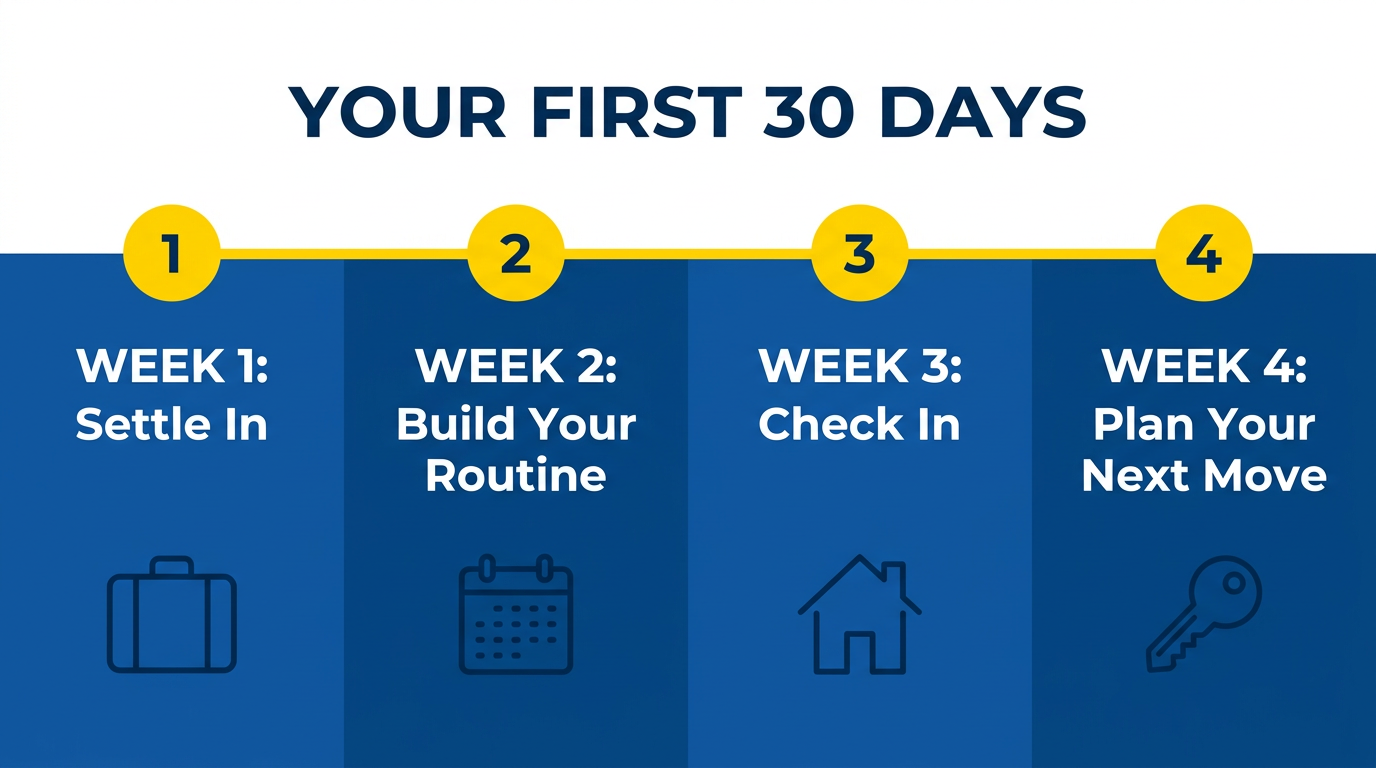
The four stages of a typical 30-day stay.
Week One: Settle In
This week is about logistics. Groceries, laundry, the nearest pharmacy, a test run of the commute. Don't try to make the place feel like home yet. Just get the basics running. Most small issues, like a sticky lock or a remote with dead batteries, show up now, and this is the best time to mention them because everyone is still paying attention.
Week Two: Build a Routine
Something shifts around day eight or ten. You stop living out of a suitcase and start using the space. The coffee goes in the same spot, the kids claim their seats at the table, and you find the grocery store you actually like. If you work from the rental, this is when you learn whether the desk and the internet are good enough. Speak up early if they aren't.
Week Three: Check In
Somewhere between day fifteen and day twenty, take stock. Is the commute workable? Is the street quiet when you need it to be? Is your timeline still the same? Plenty of stays get extended right here, because the house hunt, the insurance claim, or the project turned out to take longer than planned. If you suspect you'll need more time, say so now instead of on day twenty-eight. Availability gets tight, and an early heads-up gives everybody room to plan.
Week Four: Plan Your Next Move
The last week is for decisions. Stay on, move into something permanent, or head home. If you're leaving, ask about the move-out steps so you know where your deposit stands, and give notice the way your agreement says to. If you're staying, ask what the terms look like for another month. None of this should be a surprise.
A Real-World Example: The Contractor Who Skipped the Hotel
Here's a stay we see in some form almost every month. We'll call him Dan. He's a superintendent on a commercial project on the north side, and his company told him the job would run about six weeks. He started out in a hotel. By day nine he was eating takeout from foam containers, paying for parking, and doing his paperwork on the bed.

A real table, a real kitchen, and a short drive to the job site.
He moved into a furnished rental with a full kitchen, a proper table, and laundry on site. Nothing fancy. But he cooked three nights that first week, slept better, and stopped dreading the drive back at the end of the day. When the project stretched to ten weeks, he extended instead of starting over somewhere new.
Dan is a composite of several guests rather than one person, but the lesson is real. The longer the stay, the more the small daily comforts matter compared to the nightly rate.
Same Month, Different Needs
The first thirty days look similar for everyone, but what you should pay attention to depends on why you're here.
Displaced Families
If you're here because of a fire, a flood, a sale, or a repair, your head is probably full. Keep every receipt, and ask your insurer or case worker exactly what they need from the housing provider, whether that's an invoice, a lease, or a letter. Think about the kids too: a school within reach, a place for homework, a spot for the dog. Ask about pets before you book, not after.
Military Members and Families
Orders come with dates, and housing has to fit them. Line up your move-in with your report date and your move-out with the day your household goods arrive or your permanent place is ready. Keep a copy of your orders handy, because some providers ask for them. And ask how flexible the stay is if your timeline slips, which in the military it often does.
Professionals and Contractors
Crews and traveling professionals usually care about three things: a short drive, reliable internet, and parking that fits a work truck. If your company is paying, find out what paperwork they need up front, such as an invoice in the company name or a W-9, so you aren't chasing it later.
The One Question That Saves the Most Trouble
If we could get every guest to ask only one thing, it would be this: what is the total cost, in writing? Monthly rates are easy to compare, and they're also easy to misread. Utilities, cleaning fees, deposits, pet fees, parking, and Wi-Fi can each be included or extra. Two places that look two hundred dollars apart in a listing can flip once everything is added up.

One number for the whole month is the easiest way to compare places.
Ask for a single figure that covers the entire stay, then ask what's refundable and when. A provider who's happy to put that in writing is usually one you'll enjoy dealing with for the next month.
A Stay That Went the Way It Should
This one is another composite, built from a few families whose homes were out of commission after water damage. Picture them arriving on a Thursday evening with two kids, a dog, and four duffel bags. The keys are waiting, the beds are made, and there's a basket of basics on the counter. Parents tell us afterward that the first night mattered more than anything else. The kids slept, and the adults could finally think.

An illustration of a smooth move-in: keys, basics, and nothing left to scramble for.
Over the next five weeks they keep their receipts in one folder, send invoices to the insurer, and check in around the three-week mark, when it becomes clear the repairs will run long. They extend by two weeks with a single message. No new search and no packing boxes twice.
That's what a good stay looks like. It isn't dramatic. It's quiet, predictable, and a little boring, and that's exactly what you want when the rest of your life isn't.
Before You Book: A Short Checklist
Ask for the total monthly cost in writing, including utilities, fees, and deposits.
Confirm what's actually provided: linens, cookware, towels, laundry, and parking.
Check the internet situation if you'll be working or schooling from home.
Ask about pets, guests, and any limit on the number of people staying.
Find out how extensions work and how much notice is needed.
Learn how maintenance requests are handled and how quickly people respond.
Drive the route from the address to work, base, school, or the job site at the hour you'll really travel.
Confirm what paperwork you can get for your employer, insurer, or command.
Wrapping Up
A furnished month in San Antonio doesn't have to feel like waiting out a storm. Treat day one like an inspection, use week one to get the basics running, speak up in week two, plan ahead in week three, and decide in week four. Get the cost in writing and ask how extensions work, and you've covered most of what goes wrong.
At Legacy Crashpads, we offer furnished stays of thirty days and longer for families, military members, professionals, and contractors. If you have a date and a rough idea of how long you need, reach out and tell us your situation. We'll tell you straight whether we're a good fit, and if we're not, the checklist above will help you find one that is.
1) This material is for educational and informational purposes only and is not legal, tax, insurance, real-estate, financial, or other professional advice. 2) The information discussed may change over time and may not apply to every individual, insurance claim, or military or housing situation. 3) Property availability, pricing, terms, and policies are always subject to verification with the provider and may change without notice. 4) Nothing in this content is an offer, promise, or guarantee of housing, outcomes, or results, and it does not create any contractual commitment. 5) References to third-party platforms, companies, or resources do not imply affiliation, endorsement, or approval; always verify information independently and consult qualified professionals as needed.